
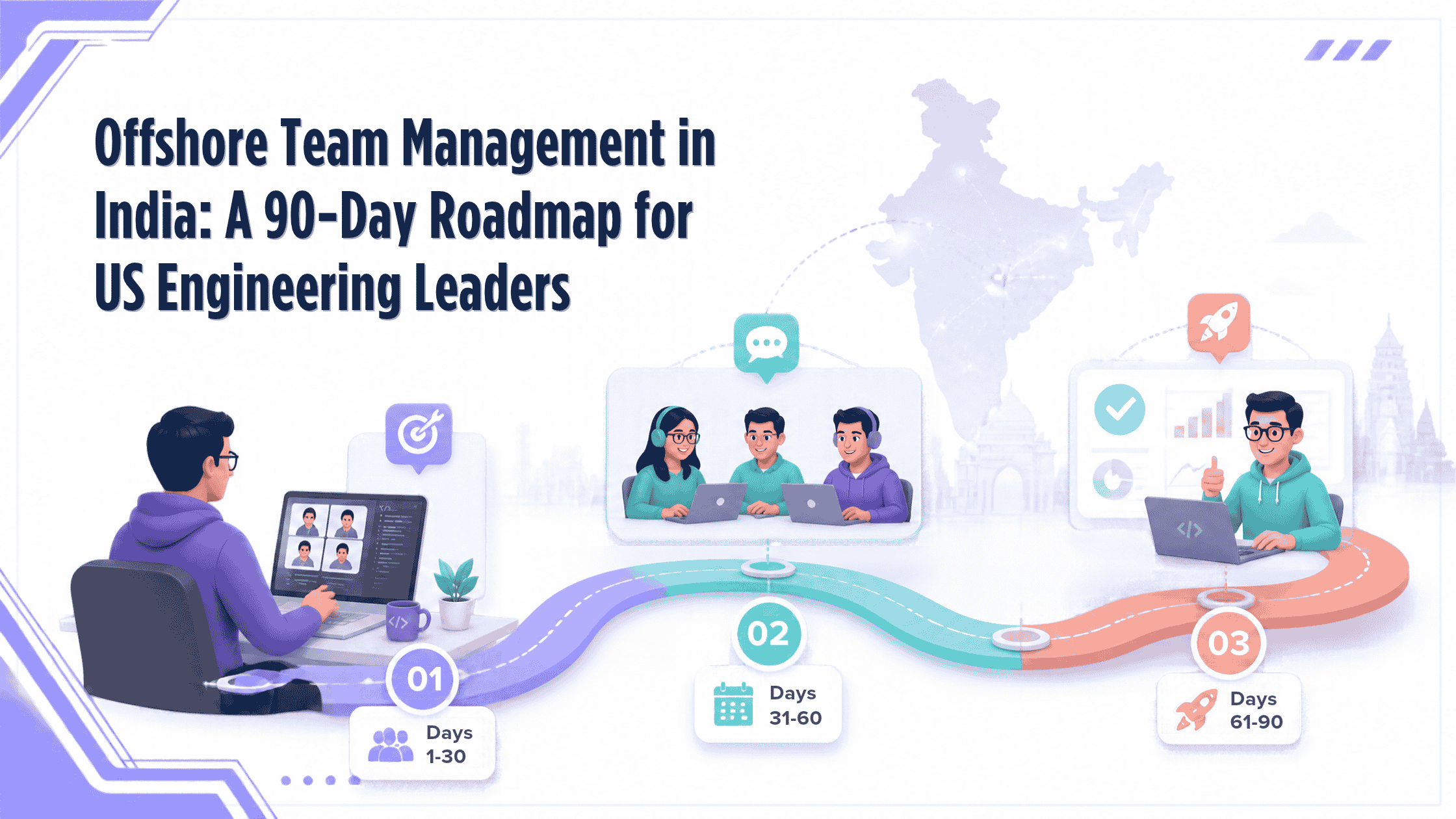
Offshore Team Management in India: A 90-Day Roadmap for US Engineering Leaders
Most advice on offshore team management is a list of tips: communicate more, use Slack, hold stand-ups. Useful, but it misses the real issue. An offshore development team in India usually succeeds or fails in its first 90 days, based on decisions made before anyone writes a line of code.
India is a proven engineering destination. A Nasscom–Zinnov study counted more than 1,700 global capability centers in India with over 1.9 million employees. The talent is there. What separates strong offshore teams from frustrating ones is the way US companies set them up and run them.
This guide gives you a phase-by-phase roadmap to build and manage an offshore team in India, from pre-launch to day 90.
Before Day 1: Set Up the Foundations
Skipping this phase is the most common reason offshore engagements stall. Settle five things before your first engineer starts.
1. Choose the right engagement model. Decide whether you need individual engineers inside your existing team (staff augmentation), a self-contained dedicated development team, or your own long-term Global Capability Center in India. Each needs a different level of internal management. If you are unsure, compare engagement models side by side.
2. Write a one-page team charter. Include the team’s mission, the product areas it owns, what “done” means, and the business outcomes for the first quarter.
3. Decide on overlap hours. India Standard Time (UTC+5:30) runs 9.5 to 10.5 hours ahead of US Eastern Time. Agree on a fixed daily overlap window of one to three hours before hiring, so candidates know the schedule up front.
4. Prepare access and security. Create individual accounts, single sign-on, multi-factor authentication, and least-privilege roles for code, cloud, and data. Use the NIST Secure Software Development Framework as a baseline, and have counsel confirm IP and confidentiality terms.
5. Assign internal owners. Name the people on the US side who will run the engagement (see the roles table below).
Who Owns What: Roles for an Offshore Development Team
Unclear ownership causes more offshore failures than skills gaps do. Define these roles explicitly.
|
Role |
Location |
Owns |
|
Engineering owner |
US |
Architecture, technical decisions, final code quality |
|
Product owner |
US |
Priorities, requirements, acceptance criteria |
|
Offshore team lead |
India |
Daily execution, task breakdown, first-level code review, mentoring |
|
Delivery or account manager |
Partner |
Staffing, replacements, performance issues, escalations |
|
Engineers |
India |
Feature delivery, tests, documentation, raising risks early |
When a JumpGrowth team is involved, the delivery role sits with the partner, so your engineering and product owners can focus on the product.
Days 1–30: Onboard and Build Context
The goal of the first month is not output. It is context and trust.
-
Week 1: architecture walkthrough, product demo, customer personas, and a tour of your repositories and CI/CD pipeline. Give each engineer a small starter task that ships to production.
-
Week 2: pair programming during the overlap window. US engineers review every pull request and explain the “why” behind feedback.
-
Weeks 3–4: assign a small, real feature end to end. Hold the first retrospective and ask directly: “What is unclear or slowing you down?”
Set communication norms in this phase: written daily updates, a shared decision log, recorded demos, and a clear rule that blockers are raised the same day. Make it explicit that questioning a requirement is welcome. Many offshore engineers have worked with clients who expected them to simply follow tickets, so this needs to be said out loud.
For a working example of this process, see how JumpGrowth builds teams.
Days 31–60: Shift From Tasks to Ownership
By month two, move the team from “doing tickets” to owning outcomes.
-
Hand over full ownership of a component or feature area, including bug triage.
-
Let the offshore team lead run sprint planning for their area, with the US product owner setting priorities.
-
Make code review two-way: India-based engineers review US code too.
-
Start measuring delivery (see the scorecard below), and share the numbers openly with the team.
-
Add specialist support where gaps appear, such as QA engineers for regression testing or DevOps engineers to stabilize the pipeline.
Watch for one warning sign: if your US engineers spend more time rewriting offshore code than reviewing it, stop and fix requirements or seniority before adding people.
Days 61–90: Measure, Stabilize, and Decide to Scale
The third month is about evidence. Review the engagement against a simple scorecard.
|
Metric |
What healthy looks like by day 90 |
|
Change lead time (DORA) |
Trending down month over month |
|
Change fail rate |
Comparable to your in-house team |
|
Pull request review time |
Under one business day |
|
Sprint commitment vs. delivery |
Consistently above 80% |
|
Rework rate |
Falling; US engineers review rather than rewrite |
|
Team stability |
No unplanned departures |
|
Overlap usage |
Blockers resolved within one overlap window |
If most metrics are healthy, scale in small steps, adding one or two engineers at a time so knowledge spreads without diluting quality. If they are not, fix the weakest area first. Adding headcount to a struggling offshore team rarely fixes it.
7 Offshore Team Management Mistakes to Avoid
-
Choosing on hourly rate alone. Compare cost per delivered feature, not cost per hour. Our guide Is Hiring Offshore Developers Worth It? covers total cost of ownership in detail.
-
No US-side engineering owner. Without one, quality drifts and decisions stall.
-
Treating engineers as ticket-takers. Context drives quality.
-
Separate repos and standards. One codebase, one pipeline, one definition of done.
-
Micromanaging hours. Measure outcomes; time tracking erodes trust.
-
Ignoring holidays and culture. Plan sprints around Diwali and Holi as you would around Thanksgiving.
-
Scaling too fast. Doubling a team before month three usually doubles the problems.
Best Practices for Managing Offshore Resources Long Term
After day 90, the work shifts to keeping the team healthy:
-
Invest in retention. Include offshore engineers in all-hands meetings, credit their work in release notes, and offer growth into lead and architect roles.
-
Visit in person. One trip in either direction in the first year builds more trust than months of calls.
-
Rotate inconvenient meetings so one side does not always take the late slot.
-
Run quarterly reviews with your partner covering metrics, staffing, and roadmap changes.
-
Document as you go. Shared knowledge protects you when people change roles.
How JumpGrowth Helps You Build an Offshore Team in India
JumpGrowth is a Texas-headquartered software development and AI consultancy. It helps US companies hire offshore developers in India and run them as integrated teams, with US-based accountability and India-based delivery.
JumpGrowth supports every phase of this roadmap:
-
Before day 1: choosing the right model, from staff augmentation to dedicated production teams or a GCC in India
-
Days 1–30: pre-vetted engineers across full stack, mobile, data, and generative AI, onboarded into your tools
-
Days 31–90: delivery management, replacements, and performance reviews
-
Beyond day 90: scaling with blended teams, including nearshore developers in Mexico and onshore developers in the USA when work needs more overlap
See results from real engagements in JumpGrowth’s case studies.
Frequently Asked Questions
How long does it take to set up an offshore team in India?
With a managed partner, engineers can often start within a few weeks. Expect another two to four weeks of onboarding before they work at full speed, and around 90 days before the team is fully stable and ready to scale.
What is offshore team management?
Offshore team management is the practice of directing, supporting, and measuring engineers who work from another country. It covers engagement models, roles, communication, security, delivery metrics, and retention.
What are the biggest challenges of managing an offshore development team?
The most common challenges are limited time-zone overlap, missing product context, unclear ownership, separate engineering standards, and weak security controls. Most are solved through setup decisions made before day one.
How do you measure an offshore team’s performance?
Use the same metrics as your in-house team: change lead time, change fail rate, pull request review time, sprint delivery rate, rework rate, and team stability. Avoid measuring hours logged.
Should I build a dedicated offshore team or use staff augmentation?
Use staff augmentation to add individual engineers to a team you already manage. Choose a dedicated offshore team when you want a complete unit that owns a product area long term.
Start Your 90 Days With the Right Partner
A strong offshore development team in India is built, not hired. Get the foundations right before day one, build context in month one, shift to ownership in month two, and scale on evidence in month three.
Ready to plan yours? Book a discovery call with JumpGrowth to map out your offshore team in India.