
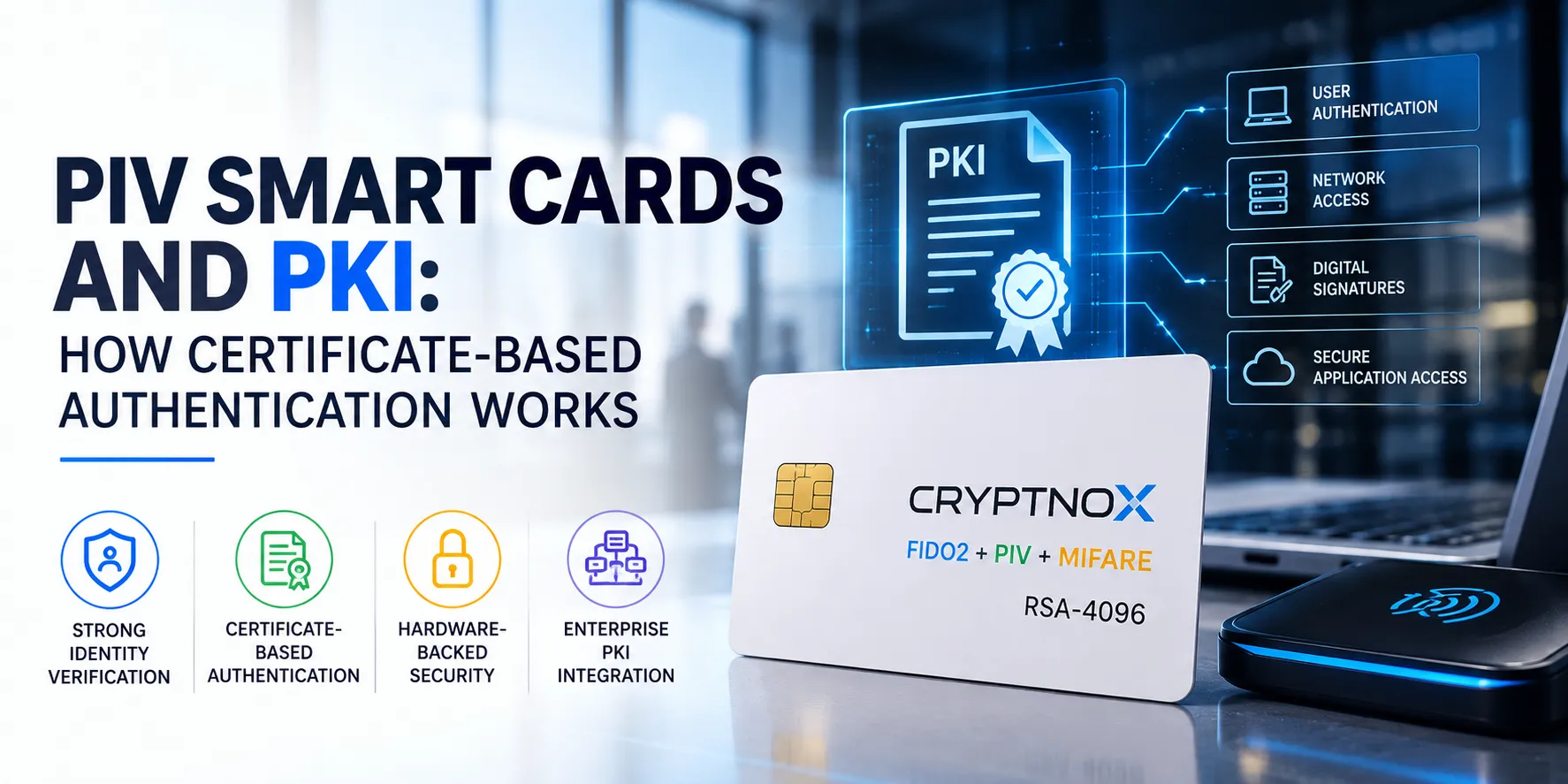
Modern enterprises need stronger ways to verify user identities without relying entirely on passwords. One established approach is to combine Public Key Infrastructure (PKI) with smart cards that store and use digital certificates. A PKI smart card provides hardware-backed protection for credentials while enabling certificate-based authentication across supported enterprise systems.
PIV, or Personal Identity Verification, is commonly associated with this model. A PIV credential can contain digital certificates that allow an authorized user to authenticate to computers, networks, applications, and other services. Instead of sending a password for verification, the authentication process uses cryptographic keys and certificates to prove control of a trusted credential.
This approach can provide enterprises with stronger identity assurance while keeping sensitive private keys protected within dedicated hardware.
What Is a PKI Smart Card?
A PKI smart card is a physical credential designed to securely store cryptographic keys and digital certificates used for authentication, signing, or encryption.
The private key is intended to remain protected within the smart card rather than being freely accessible to the operating system or application. When authentication is required, the card can perform a cryptographic operation that proves possession of the corresponding private key.
A typical PKI smart-card environment includes:
-
A smart card containing certificates and protected private keys
-
A certificate authority (CA) that issues trusted certificates
-
Enterprise systems configured to validate certificates
-
Card readers or compatible interfaces
-
Identity and certificate lifecycle management processes
This creates a chain of trust between the user’s credential and the enterprise systems that recognize it.
How Does Certificate-Based Authentication Work?
Certificate-based authentication uses asymmetric cryptography. A user receives a digital certificate containing a public key and identity information, while the corresponding private key remains protected.
During authentication, the server can issue a challenge that the user’s credential must cryptographically respond to. The smart card performs the required operation using the private key.
The basic process is:
-
The user presents the smart card to the authentication system.
-
The system requests authentication.
-
The credential uses its protected private key to perform the required cryptographic operation.
-
The server validates the resulting response using the public key in the certificate.
-
The certificate chain and associated policies are checked.
-
If the credential is trusted and valid, authentication can proceed.
The private key does not need to be exposed to the host computer simply to prove that the user controls the credential.
What Is a PIV PKI Card?
A PIV PKI card combines the PIV credential model with PKI-based certificate authentication. PIV credentials can support identity verification and certificate-based operations across compatible enterprise environments.
Organizations can use PIV credentials for applications such as:
-
Windows authentication
-
Enterprise network access
-
VPN authentication
-
Digital signatures
-
Secure email
-
Certificate-based application access
A PIV certificate authentication workflow relies on certificates, private keys, trust relationships, and appropriate enterprise policies rather than simply checking a username and password.
The exact capabilities depend on the certificates issued, enterprise configuration, operating system, applications, and authentication infrastructure.
Why Hardware-Backed Certificate Authentication Matters
One of the major advantages of smart-card authentication is the use of dedicated hardware to protect private keys.
With conventional software-based credentials, sensitive key material may be exposed to the host environment depending on the implementation. A smart card can create a stronger security boundary by performing cryptographic operations internally.
Hardware-backed certificate authentication can therefore help reduce the exposure of private keys while providing a physical credential that users can carry.
This is particularly relevant for organizations handling sensitive systems, regulated information, privileged accounts, or critical infrastructure.
However, hardware protection is only one component of enterprise security. Organizations still need secure certificate issuance, revocation, endpoint protection, access policies, and credential lifecycle management.
What Is an Enterprise PKI Smart Card?
An enterprise PKI smart card is designed to operate within an organization’s broader public key infrastructure.
PKI allows an organization to establish trust between certificates, users, devices, and services. A certificate authority can issue certificates according to defined identity and security policies, while systems can validate whether those certificates are trusted and still valid.
Enterprise PKI typically involves:
Certificate Issuance
Certificates are issued to approved users or devices after an identity-verification process.
Certificate Validation
Authentication systems verify the certificate’s issuer, validity period, trust chain, and applicable policies.
Key Protection
The corresponding private key should remain appropriately protected, particularly when it is used for high-value authentication or signing operations.
Certificate Revocation
When a credential is compromised, lost, or no longer authorized, its certificates may need to be revoked or otherwise invalidated.
This lifecycle is essential. Deploying smart cards without proper PKI governance does not automatically create a secure authentication environment.
PIV Smart Cards for Enterprise Authentication
PIV smart cards can be useful where organizations require strong identity assurance and certificate-based authentication.
For example, an employee could use a smart card to authenticate to a Windows workstation. The workstation validates the user’s certificate against the organization’s trust infrastructure. Depending on the deployment, the same credential may support other certificate-based services.
A PKI smart card can therefore become part of a broader enterprise identity architecture rather than functioning as a simple identification badge.
For organizations already operating PKI infrastructure, a PIV PKI card can provide a physical credential for certificate-based authentication workflows.
PKI Smart Cards and Digital Signatures
Certificate-based credentials can also support digital signatures.
A user can use a protected private key to generate a cryptographic signature for a document or transaction. A recipient can then use the corresponding public key and certificate to verify the signature.
This can help organizations establish:
-
Who signed the document
-
Whether the document was altered
-
Whether the signing certificate was trusted at the relevant time
A certificate authentication smart card may therefore support more than workstation login when configured for appropriate enterprise applications.
PIV, PKI and Modern Authentication
While certificate-based authentication has existed for years, it can coexist with newer authentication technologies such as FIDO2.
FIDO2 is designed around modern passwordless and multifactor authentication workflows, while PIV and PKI provide certificate-based identity and cryptographic credentials.
Organizations should choose authentication mechanisms according to their applications, infrastructure, risk profile, and operational requirements rather than assuming that one technology is suitable for every environment.
Conclusion
A PKI smart card provides a hardware-based method for protecting cryptographic credentials and supporting certificate-based authentication. When combined with PIV and an appropriately configured enterprise PKI, it can provide a structured approach to identity verification across supported systems.
The core security principle is straightforward: certificates provide a trusted public identity, while the corresponding private key remains protected and is used to prove control of that identity.
For enterprises, successful deployment depends on more than the card itself. Certificate issuance, trust management, revocation, endpoint configuration, authentication policies, and credential lifecycle processes all contribute to the overall security model.
When these components are properly integrated, PIV and PKI can provide a robust foundation for hardware-backed enterprise authentication and digital identity management.